Begin with a padam
Alasara paritapamu
'Parvathi', residence of K. Srikantaiah, Chamarajapuram · Mysuru · 1976
A tribute · Carnatic flute
For those who return to KSG’s music, and those discovering it for the first time.
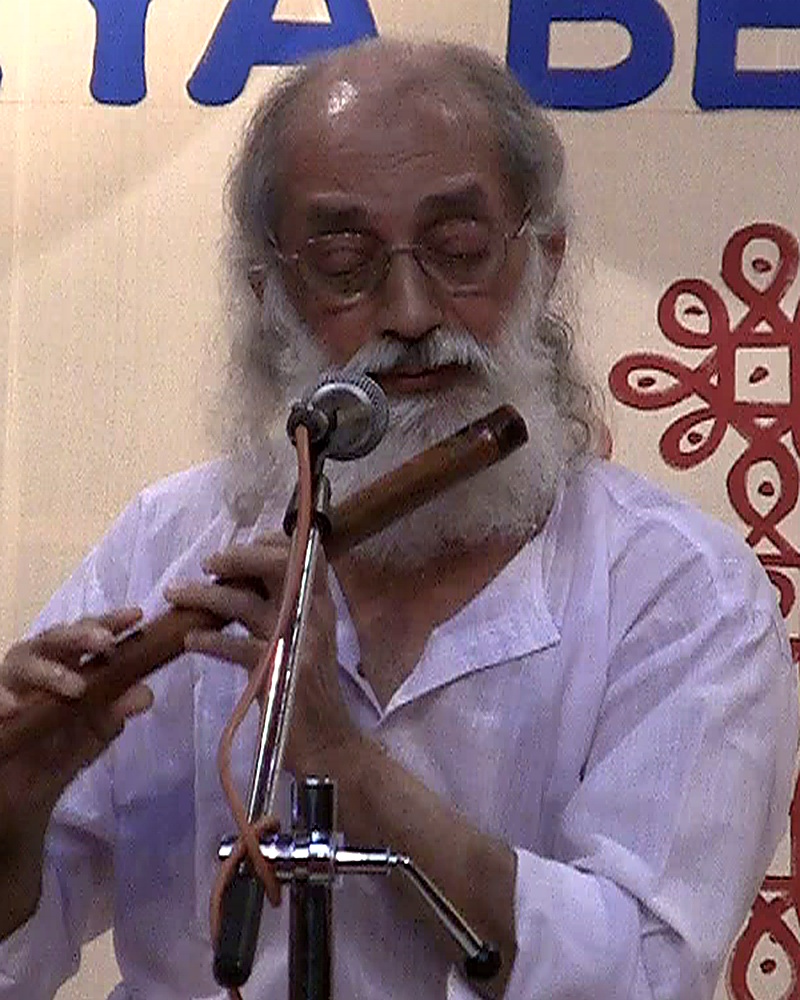
An invitation
Three ways into the collection.
Each link opens a particular rendition.
Begin with a padam
'Parvathi', residence of K. Srikantaiah, Chamarajapuram · Mysuru · 1976
Hear a concert opening
'Parvathi', residence of K. Srikantaiah, Chamarajapuram · Mysuru · 1976
Settle into a longer rendition
Goregaon · Mumbai · Date not recorded
The tribute
Listeners return to one word when they speak of K. S. Gopalakrishnan: soukhyam, the quiet ease and repose they found in his music. Across concert platforms in Kerala, Mumbai, Bangalore, Mysore, and North America, and through decades of broadcasts from All India Radio Thiruvananthapuram, his music offered an antidote to haste. Instead of chasing rapid tempos or stage display, KSG cultivated an unhurried, vocal purity that gave each raga room to breathe.
His flute had a warm, rounded tone, grounded in the resonance of the lower octave, the mandra sthayi. In recitals such as his 2010 performance at the Indian Institute of Science, he would set aside his primary flute to bring out a longer, lower-pitched bass bansuri for pieces like Venkatachala Nilayam, filling the hall with a deep, quiet hum. His breath control was exceptionally steady, letting delicate oscillations and microtonal slides emerge with natural grace.7, 3, 6
KSG played the flute in the gayaki tradition, treating it as an extension of the singing voice. His All India Radio colleague Sivaramakrishnan remembered him as a votary of pure music who never played to the gallery. He avoided repetitive fingering patterns, focusing instead on the lyrical weight of the compositions. In reviews and listener recollections, his alapana phrases are often heard drawing straight from the kritis—such as a phrase from Samajavaragamana surfacing naturally within his exploration of Hindolam, delivered with a deliberate gravity that recalled the vocal delivery of M. D. Ramanathan.2, 8, 4
Time moved differently in KSG's recitals. A listener attending a live concert once looked at his watch during the second composition and was surprised to discover that a full hour had already slipped by. At Indiranagar in July 2010, eight compositions unfolded over three hours and fifteen minutes without a single speech or interruption. In major ragas—Bhairavi, Kharaharapriya, Shankarabharanam, Purvikalyani, and Todi—he developed each phrase with patience, building upward from the lower octave. His tanam carried the rhythmic clarity and cadence of a veena. Milestone recordings—such as his hour-long Kharaharapriya with Rama Ni Samanamevaru in the April 1976 Mysuru concert, his Balagopala in Bhairavi, and the acclaimed 1993 North American tour Brindavani Saranga RTP—remain touchstones for listeners.5, 2, 3, 4
That musical repose extended across the stage. KSG treated accompanists as partners in the music rather than a backing section, creating an atmosphere of shared warmth. Stalwarts of Carnatic accompaniment—including violinists T. Rukmini, M. Chandrasekharan, A. Kanyakumari, and the Mysore Brothers, alongside percussion masters Tanjore Upendran, Guruvayur Dorai, Umayalpuram Sivaraman, and Mannargudi Easwaran—performed with him with audible affection. In concert recordings, accompanists frequently respond to his phrases with spontaneous praise. At Gayana Samaja in 2010, Mannargudi Easwaran took up rhythmic patterns directly introduced by KSG’s flute and wove them into his percussion solo, reflecting an ensemble listening closely to one another.9, 3, 8
Born in Kerala on 1 September 1948, KSG was introduced to the flute at age nine by his father, violinist K. Sankaranarayana Iyer, before undergoing rigorous advanced mentorship under Sri K. Raghava Variyar of Thiruvananthapuram. He made his stage debut at fifteen and won First Prize in the 1965 All India Radio National Music Competition at seventeen. During the 1970s, he balanced music with academic scholarship, graduating with a First Class master’s degree in Economics from Kerala University. Rather than entering the commercial sabha circuits, KSG chose the quiet discipline of a staff artist at All India Radio Thiruvananthapuram, serving for more than three decades until his retirement in 2006. His flute became a signature sound of early morning broadcasts like Udaya Geetham, where he performed alongside vainika R. Venkataraman and vocalists Neyyattinkara Vasudevan and Radha Namboodiri.12, 13
While indifferent to public acclaim, his artistry received prominent national and international recognition. In 1991, the German label WERGO recorded his live recital at Sangeet Natak Akademi in New Delhi for the album Carnatic Flute, and in 1992 he toured Germany, the Netherlands, and Austria with ghatam vidwan Tripunithura Radhakrishnan. He was honored with the Kerala Sangeetha Nataka Akademi Award for flute in 1999 and the Veena Seshanna Memorial National Award in 2010. Following personal bereavement in the mid-2000s, he stepped back into quiet seclusion. When he performed for research scholars at the Indian Institute of Science in 2010, he simply said he hoped the music offered them some peace from their taxing labors. As a fellow flautist in the audience remarked, while musicians strive to learn his technique, emulating his humility is the rarer gift.15, 14, 16, 10, 7
Because KSG chose a life away from commercial promotion, his music has been kept alive by a devoted community of rasikas, collectors, and fellow musicians. Today, young classical musicians study his recordings alongside those of M. D. Ramanathan and Lalgudi Jayaraman to absorb the subtleties of raga expansion and unhurried phrase design. Across five decades of recorded concerts—tapes carefully preserved, digitised, and shared between listeners around the globe—his music continues to offer quietude and wonder. This collection is offered in gratitude to K. S. Gopalakrishnan, and to the community of listeners who preserve his art.17, 1, 3